
Notes from Harbor
Your Wellness Studio Website Mobile Booking Is Quietly Costing You Clients
A wellness studio website mobile booking flow that lags loses bookings every night. Here is what to fix, and the wellness studio website designer toolkit.
Notes from Harbor
A wellness studio website mobile booking flow that lags loses bookings every night. Here is what to fix, and the wellness studio website designer toolkit.
A returning client of ours, a postpartum mom in Gloucester, sat on her couch at 9:07pm on a Tuesday trying to book a 90-minute couples massage on her phone. She tapped the date picker. It half-loaded. She pinched to zoom. A newsletter popup ate the screen. She dismissed it; the date picker had reset. She tried once more, got a calendar showing March when it was already April, and gave up. We know because she texted the next morning: tried to book last night, your wellness studio website mobile booking is broken, can you just do it for me? She is one of the lucky ones. Most clients just close the tab.
If you run a wellness studio, day spa, or boutique bodywork practice, your problem is rarely that people cannot find you. They find you on a phone, at night, while their toddler is finally asleep, and your site does not meet them there. The fix is not your booking platform. It is the CMS underneath your marketing site - and, increasingly, the wellness studio website designer who maintains it for you when you are running back-to-back appointments and cannot babysit a page builder.
If you would rather skip the diagnosis and see the fix, book a 20-minute Workspace CMS walkthrough and we will show you, on your own URL, where the gap is.
Across the small studios we audit, the pattern is consistent: roughly 78–82% of website sessions are mobile, and roughly 28–34% of completed online bookings are mobile. These are industry averages from studios we have worked with, not a published study, but the shape is the same every time. Phones dominate intent. Desktops dominate completion. The 50-point gap between traffic share and booking share is your site quietly leaking revenue.
Some of that gap is genuine behavior - browse on the train, book from a laptop later. But most is friction: slow images, layout shift while a hero loads, a modal that fires before the page is readable, a date picker built for 1280px shoved into 390px, a “book now” that opens a widget in a new tab and never returns. The compounding effect is brutal, because the people you most want - new clients in the prenatal, lymphatic, and couples-massage segments - are almost exclusively phone-first.
Every one is fixable, and most at the CMS layer rather than inside Mindbody, Booker, or whichever scheduler you already pay for. A real spa web design agency earns its retainer by closing this gap month after month, not by re-skinning your home page every two years.
After auditing dozens of studio sites, the same five offenders show up. None are exotic. All are within the control of a competent CMS and the team that runs it.
A 2400px hero of a treatment room at 1.4MB is fine on fiber. On LTE in a coastal dead zone, it is a four-second blank screen. Largest Contentful Paint over 2.5 seconds correlates with the back-button behavior we see in session recordings. The fix is responsive images in modern formats, served automatically - not a quarterly “speed audit” from a freelancer.
A “10% off your first facial” modal three seconds in is the single most common reason a first-time visitor leaves without booking. They came to read about your couples massage, not hand over an email. Use exit-intent on desktop only, or skip the popup on phones entirely.
Paste a scheduler embed in and you get whatever was acceptable on mobile in 2019: calendar taller than the viewport, close button off-screen, modality selector a 47-item native dropdown. Deep-link to the vendor’s hosted booking page instead, and let the page-level metadata do the SEO work.
Many studios publish intake as a PDF link - on mobile, that is a PDF in a tab the client cannot type into. They show up cold and your therapist does intake at the table, eating into hands-on time the client paid for. Move intake to a real mobile form with conditional logic for contraindications (pregnancy, recent surgery, anticoagulants, active skin conditions) and you protect both the modality and the booking value.
Yoga, barre, sound bath, infrared sauna circuits - if a returning client cannot, in three taps, see what is on Thursday after 6pm, she will not book. Filter by modality, instructor, and time-of-day. Default to today and tomorrow. Hide the seven-day grid.
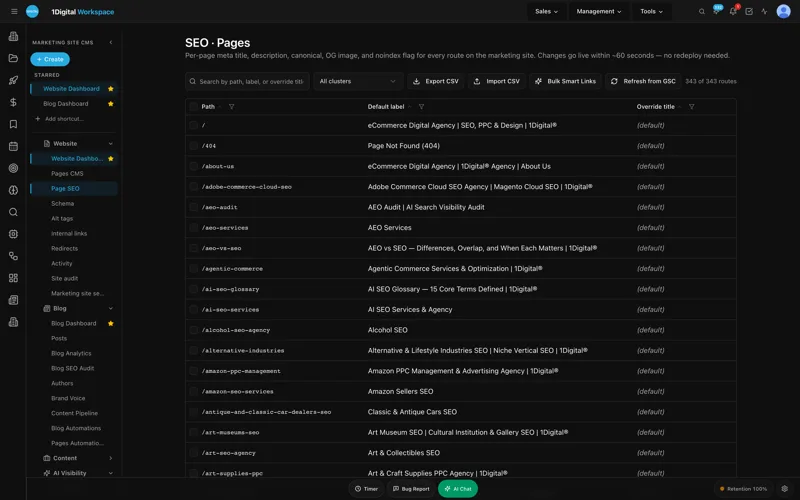
The reason most studio sites stall is not aesthetic - it is operational. The team that built it cannot get back into it fast enough to fix things. Workspace CMS is built around a small set of features that, together, let a one-person marketing seat (or a managed agency desk) run a studio site without ever touching code.
The pieces we lean on most for wellness brands:
LocalBusiness, HealthAndBeautyBusiness, Service, and FAQPage schema. This is what makes “prenatal massage near Cape Ann” surface your service card instead of a competitor’s home page.None of these are bolt-ons. They ship with every tenant. You can poke at them in the live demo gallery- the wellness, medspa, and beauty demos all run on the same admin you would get.
UNLIMITED MANAGED CHANGES
Send a ticket. We ship the change.
Every Workspace CMS plan includes unlimited managed CMS edits - every seasonal package launch, every new modality page, every practitioner bio, every holiday-hours banner. Essentials ships in 4 business days. Growth ships in 2. Premium ships in 12–24 hours. No per-edit fees. No “open a Jira” overhead. Just describe what you need and our team builds it on your live site.
Every studio owner has heard “Core Web Vitals” from someone. The useful version: Google measures, for every real visit, how fast the main content loaded (LCP), how stable the layout was while loading (CLS), and how quickly the page responded to the first tap (INP). Those scores feed local search ranking and proxy almost perfectly for whether your mobile bookings convert.
Workspace CMS bakes the optimization in. Image optimization is automatic - upload a 4MB iPhone photo of your salt room, get a responsive WebP set on a global CDN. Layout shift is prevented because image dimensions are reserved at render. You configure none of this. The alternative is paying a developer hourly every quarter to re-tune a WordPress stack - we have seen studios spend $1,800 a year on “speed maintenance” and still fail the Vitals report. The managed-change workflow means the team that built the site is also the team keeping it fast.
Workspace CMS has three tiers. For a single-location studio, the right answer is almost always the middle one.
For a single-location studio in a town like Rockport, Growth is the right answer. Someone on the other end of a ticket swaps your seasonal hero, adds a modality page when you hire a new practitioner, and ships blog posts - without you opening a CMS. Full numbers on the pricing page, and other small-brand walk-throughs in the case studies gallery.

Most owners we talk to have been through the cycle: hire a generalist wellness brand website company or a freelance designer, get something pretty, watch it decay over 18 months, repeat. The decay is not a design failure. It is an operations failure - nobody is on the hook for keeping the site current after launch, so the seasonal copy goes stale, the schema drifts, and a new modality lives only on the Instagram bio.
What an industry-aware day spa marketing agency brings is a maintenance posture. The hero is updated when the season changes. The blog publishes on a real cadence, with brand-voice-locked drafts queued in the Content Pipeline Board. The structured data is corrected the same week Google deprecates a property. The Site Speed dashboard is checked weekly. None of this is exotic; all of it is the difference between a site that books at 3.2% mobile conversion and one that books at 1.1%.
The quiet worry: are you telling me to leave Mindbody? No. Mindbody, Booker, Vagaro, Acuity, Square Appointments - these handle memberships, packages, gratuity, payroll, and PHI considerations. You do not want a CMS to replace them.
You want a CMS that hands off cleanly. A “Book Swedish 60” button on your modalities page should deep-link to the specific service in your scheduler, mobile-tuned, with context preserved. Your CMS owns the marketing surface; your scheduler owns the transaction. The seam needs to be invisible on a phone.
The tagline - “An AI-first, SEO-first CMS. Need a change? Just ask.”- is literal. Send a ticket: “Add lymphatic drainage, $145 for 60 minutes, contraindications include recent cancer treatment, link booking to this Mindbody service ID.” Two business days later it is live, internally linked, schema-marked by the Structured Data Editor, and on the auto-regenerated sitemap. If that is the operating model you want, start a strategy call and we will scope the migration.
No. Most clients launch in 2 weeks. The 1Digital team migrates your pages, redirects old URLs through the Redirect Manager with conflict detection, and stands up the new site on Vercel. No page-builder fighting, no HTML required.
Yes. Workspace CMS sits in front of Mindbody, Booker, Vagaro, Acuity, or Square Appointments. The CMS owns marketing pages and blog; your scheduler owns the transaction. Integration is a deep link or embed, configured per service.
Intake forms collecting protected health information should live in your scheduler or a dedicated intake tool, not the marketing CMS. Workspace CMS can host a pre-screening form, but anything touching contraindications, medications, or medical history belongs in a compliant system.
It checks whether ChatGPT, Claude, Perplexity, and Gemini surface your studio when someone asks “best couples massage in Rockport” or “prenatal massage near Cape Ann.” If you are missing, the weekly digest tells you why - usually thin service pages or missing schema - and the AI Content Audit ships one-click fixes.
Yes. The rich-text Page Editor has scheduling, the AI Blog Generator can draft from a prompt in your locked brand voice, and Owner/Editor/Viewer roles plus an audit log let a front-desk lead publish safely. Or send a ticket and the team ships it on your tier’s SLA.
If your mobile booking flow is quietly leaking clients - and unless you have audited it recently, it almost certainly is - the fastest path back to those bookings is not a new scheduler. It is a fast, mobile-first marketing site managed by a team that treats your CMS as a workflow, not a deliverable. Schedule a Workspace CMS walkthrough and we will show you, on your own URL, exactly where the gap is and what closing it would cost.
Begin gently
Your first class is on us. Tell us roughly when you're free and we'll hold you a mat - the form takes about a minute, and someone at the desk replies the same business day. No card on file, no membership pitch.

